The Ultimate Guide to Finding, Financing and Negotiating Your Danish Apartment 🇩🇰
Hi, I'm Mario Scian 👋🏻
I've spent hundreds of hours learning and researching about buying an apartment in Denmark.
If you're an expat in Denmark, this guide will be the best resource on the internet to help you find your next home and pay the best price for it.
My Background & Why You Can Trust Me
I'm from Argentina and I've been living in Copenhagen for more than ten years. I work at Maersk, where I'm buying things professionally — think of ports, ships, fleets of trucks, etc. Big things.
I bought my first apartment in Copenhagen in 2017. (And then a townhouse in 2025 🎉!)
I'm obsessed with the details, and there are a ton to look into: laws and lawyers, financing and interest rates, taxes and fees, a crazy-fast real estate market.
I spent hundreds of hours looking through all that. I met lawyers, realtors, all major banks, and a multitude of advisors. I spent months learning about the real estate market and visited dozens of apartments.
All the way, I wished there was *one* guide that would outline everything I needed to know.
I could never find one — so, alas, here we are.
I wrote this monster, 40-page guide so you've it easier than I did. I wrote it so you save time and get straight to what you want — to get that new apartment.
It's all free, no strings attached. No catch.
Who This is For 👇🏻
This is a guide for foreigners in Denmark. There are rules for Danes and for everyone else. In this guide, I focus on everyone else.
This is a guide to buy an ejer property. I barely touch on andels. For summer houses, I made a separate guide.
This is primarily a Copenhagen-guide. That's where I've been living. Still, I would assume that most of this will also apply in Aarhus, Odense and beyond.
This is not a guide for Danes (though it can help you if you're one), nor a guide on buying property elsewhere in Europe.
⚠️ Disclaimer — If you're serious about buying an apartment, you should talk through all the relevant details with your legal and financial advisors. This guide is for informational and entertainment purposes only. I don't take any responsibility for you bidding on any property.
Before We Start — Know What You're Doing 🚨
With that said, a few words of advice:
Buying a property will be in most cases the biggest purchase of your life. You need to know what you're doing, and that's where this guide will help.
Buying a property is not necessarily a good investment. People have been conditioned to think that buying a house is an excellent financial decision — in the majority of the cases, it's not. An apartment can be a liability, especially if you buy high and have the wrong mortgages.
Properties are illiquid assets. They're expensive and hard to sell. It's risky to tie the majority of your net worth in an asset like an apartment.
Still, if you do it right, you can look forward to have more money in your pocket each and every month, and a big pay day when you sell.
Index — How This Guide is Structured 🧭
The guide is divided into three sections:
First, you'll get an overview of the housing market in Denmark. Specifically — you'll see whether it's a good time to buy or not, which are the rules and laws you should know, and the types of financing available.
Second, you'll look into the how to find the "right" apartment. Specifically — what are the right locations, what are fair square meter prices, what is the "ejerudgift" and all the relevant information you should take into consideration.
Third, you'll learn what you need to start bidding for properties, and how to negotiate the lowest purchase price possible.
⚡️ Save This Guide + Get Unlimited Access
Get free access to ALL my resources (videos, Q&As, etc.)
Yes - It's probably a good time to buy. I think that so long as the economy keeps strong, prices won't go down. If you're buying for the medium to long-term, go for it.
…and, for context, I say this with skin in the game. I bought a townhouse in Copenhagen in February of 2025. (So, that's the second property I buy here already).
That said, the future is always full of uncertainties. There's a trade war heating up, geopolitical uncertainty and looks like there's chaos everywhere. It's never clear cut.
But I've a lot of confidence in the market now that we'd interest rates climbing and higher taxes kicking in and prices still went up.
For More Context
In Denmark in 2022 and 2023 we've seen interest rates go up from 1% to between 5% and 6% (now down at around 4%), we've an unprecedented inflation and energy crisis, all while higher housing taxes kicked in in 2024 for apartments in the big cities…
All this happened and prices still went up. Hence, my simple recommendation is that if you plan to buy for the medium/long-term — so five years plus — go ahead.
BUT — If you're looking into a shorter-time frame — e.g. you plan to live in Denmark for only the next 1–3 years, or you just want to speculate — then I would be a bit more wary.
In all cases, don't be emotional and search for a great deal. In down markets you can have incredible opportunities — and that's what I'll help you find and capitalize on in this guide!
🇩🇰 To get my most up-to-date analysis and (if you want) get feedback from me personally, click here.
The Case for Denmark — The Fundamentals
In all cases, I write "buy for the long term", and that's because the fundamentals in Denmark remain strong:
This as historically — across the board — house prices have risen, at least in nominal terms. Prices can crash tomorrow (or in 3 years), but it's very likely they'll go up again over the longer term.
Still, this is just my opinion. It's not a sure bet — we can't predict the future, and trying to do so is risky at best.
The Objective View
Up to now, I've been generalizing. If you should buy or not will depend on your specific case. However, if you look at the data, it might be a smart move:
First — Copenhagen is not too expensive relative to other major European cities, as you can see in the below price per sqm meter in central locations:
Prices for Apartments in City Center (Data as of 2026)
Paris
€14,000
London
€12,500
Amsterdam
€8,500
Munich
€9,200
Copenhagen
€6,800
Stockholm
€7,100
*Second — For the EU (and the developing world), high interest rates are unsustainable. It's a matter of time for rates to come down, or, even, until the European Central Bank starts "printing" money via QE again. Once that happens, all that cash will — again — flow to drive asset prices — all* assets — up in value.
*Third — If the alternative is to pay a high rent — as it is for most people — it is likely that you can get a cheaper* deal on a per-month basis by buying. This, of course, will depend on how high your rent was and to what type of loans you'll get access to.
🌀 What Should You Know About the Danish Market?
OK — Now we move from the realms of speculation to the actuals:
*First —* Denmark has a lot of cheap, subsidized social housing. If you can rent a social apartment, you'll have a better deal than buying one. There are waiting lists and all that, but, if you do get a subsidized apartment, you'll pay so little in rent that you'll have plenty of leftover cash to invest in more liquid and higher-performing assets than real estate.
*Second — Denmark is a very competitive real estate market, especially at the lower-end. If you're looking to buy a 1 to 3 million DKK property, you'll have a lot of competition in normal times. This will make you pretty "powerless" — and, because of that, you'll struggle to get a good deal. The reason for all this is that the entry barriers are very low — loans are normally* very cheap, and banks only require 5% of the value of the property as a down payment.
*Third and Most Important —* There is "discrimination" against foreigners in the Danish real estate market. For this one, let me elaborate:
If you're not Danish — and even if you're a European Union citizen, mind — banks and advisors won't treat you in the same way as if you were a Dane. You won't get the same deals.
Specifically, you might need to put higher down payments (not 5%, like a Dane — but 10%, or 15%, or sometimes more), you might not get offered specific loans (e.g. "no repayments", yearly updated interest), and you might not be able to borrow as much as a Dane.
This is not an opinion — is a fact. I'm EU citizen, and so is my wife. We both have good, well-paid jobs at Maersk, and had enough capital to put 20% as a down payment for most properties. Still, despite all this, one bank didn't want to give us a "no repayments" loan and access to the most flexible and riskier products.
It's not like this always, but I've heard the same stories from almost all my foreign friends. The only way around this is to meet more banks and more advisors. Some are just too conservative.
There's a rationale for this anti-foreigner bias though. Banks are afraid that — if all goes to hell, say, with prices crashing 50% — you'll foreclose your apartment, default and move back to your country — leaving the bank with the house in negative equity and wishing them "good luck".
Danes technically can't do that, but if you as a foreigner do, the bank will be pretty powerless to prosecute you once you leave the country.
+ Besides all this, there are specific laws that "discriminate" against non-Danes, and participating in auctions can also be complicated if you're not a Danish citizen. More on this, in the next section.
Rules / Laws You Need to Know — Before You Even Start Looking! 📚
There's a multitude of housing-related rules and laws in Denmark and most are very complex. Here's the rundown of the most important ones:
Ejer vs. Andels — Definitions
There are two major types of apartments/houses in Denmark — "Ejer" and "Andel".
For "Ejers":
✓*You're the owner of the flat*, and, similar to in other countries, you pay for joint expenses as cleaning of the halls, the vicevaerten ("house master"), garbage removal, building insurance, etc. to an owners' association called the "ejerforening".
✓As it's your apartment, *you can do what you want with it.* You can rent it out, do Airbnb, add and remove walls, and do all sorts of stuff that would be normal in every other country.
✓Still, there are some rules set by the ejerforening — for example, you can't change the outside/facade of your apartment, and you can't turn the place into a heavy metal band rehearsal studio.
✓If you buy an Ejer, *you can get all the cheap and fancy loans*.
For "Andels", things are different:
✗For Andels, *you're not the full owner of the flat* — you are an "investor" or shareholder in an association that owns the building.
✗As you're not the "owner", you give up power and control to the association. *Andels have a lot more rules and regulations*, and they're often very strict.
✗For example, *you can't rent out your andel* — or, if you're able to, you can only do so at a fixed, low price and for a set period of time, and only after receiving approval from the association.
✗*You're also not allowed to set the selling price,* if you decide to move out. Instead, the selling price is fixed by the association.
✗On top of the regulations, *the running costs for andels are usually much higher* than for the ejers — both the joint expenses to the association and the loans to buy the andels are more expensive than for ejers.
This looks gloomy, right? But, andels have one thing in their favor — the buy-in price is often much lower than for en ejer. There's also, because of all the above, good and bad andels — but the best andels have a waiting list and are hard to "catch". (It helps to have friends inside the good andels, ready to help you jump that list.)
Should You Buy Andels?
Because of this, I didn't buy an andels and I researched and prepared to buy an ejer instead. The rest of the guide is ejer-specific.
The Other Rules You Should Know
To Buy and Sell:
*Down Payment Requirements.* You need minimum 5% of the purchase price to buy a property. That's by law. For foreigners, the banks can and often will ask for more.
*Loan Multiplier.* Banks won't loan you more than 4x times your yearly gross (pre-tax) salary. If you want to buy something that costs more than 4x times your income, you need to put in a very big downpayment. Banks used to be more generous, but the government has since made this more constrained.
*Capital Gains. Let's say you bought your apartment for 3m. If you would sell it for 5m, you'll have a capital gain of 2m. In Denmark, this gain is not taxed*. Hard to believe, considering that Denmark is the highest-taxed country in the world and basically everything else is taxed (and very highly so). There's a catch, though — you don't pay capital gains if you've been living in the property you're selling. If you bought, rented it out, and then sold, you'll need to pay 35% of the gain or more to Skat.
*Living-Needed Apartments. In Denmark, there's something called bopælspligt*. If your apartment has this — and 99% of them do — it means that the apartment can't be empty for more than six months. You're thus obliged by law to rent out your apartment if it's empty.
*The 5-Year Rule for Foreigners. If you're not a EU/EEA citizen, you need to get permission from the Danish Ministry of Justice to buy a property (your lawyer will usually handle this). Then, even if you're a EU/EEA citizen (and of course, for all other non-Danes), you're still bound to the 5-Year Rule. This is: if you buy a property before living in DK for five full years, and you then you move out (for whatever reason) out of the country, you'll then be obliged to sell the property within six months.* You can't keep it. If the market had just crashed at that time — tough luck, but you need to sell anyway. (If you bought after three years in Denmark, but have now lived in the country for more than five, this requirement is waived. You're good.)
To Rent:
*Rent Control. There's rent control for most properties in Denmark. This means that you can't rent your apartment for more than a specific set amount, which depends on your kommune, on the size of the property, and on whether the place is furnished or not. In most places, this "controlled rent" is well below market price. If you've a big loan, this means that if you need to rent out your place to someone at the official rates you're likely to lose money*.
*You Can't "Cheat" Rent Control. Or, technically, you can, but, if the tenant goes to the government "rental board" (an institution), and the rental board inspects the property on the tenant's request and finds you've been charging more than you should by law, you will be obliged to: a) lower the tenants rent to the "official" level, and b) pay the tenant back the difference between what you charged him/her and what the "official" level is for the accumulated time he/she has been living there*.
Boom. I know friends that had to pay up — it's nasty, and you can lose a ton of money.
Now — *this rule doesn't apply for apartments in buildings built after 1992. If you bought an apartment in a building built in, say, 2000, or in 2012, you're allowed to rent it for as much as you want. (This opt-out doesn't include renovations — it has to be a new building*!)
2-Year Renter Rule. If someone has been renting your apartment for more than two years, you can't kick them out anymore — and you can't change the conditions of the contract (rent, etc.) either. So, technically, it's possible that you might end up with someone paying rent-controlled prices in your apartment indefinitely and lose a gigantic sum of money in the process. (I guess you can sell, too).
You can only kick the tenant out if you moved in to the flat yourself — but need to give a one year notice. The best way to go around this, if it comes to it, is to a) rent your apartment to trusted people (friends, colleagues, etc.), b) rent through a company, which will handle all the paperwork, and do so for one-year period or similar.
Important!
As you can see, it can be very tricky to rent your apartment in DK — if you plan to do so, meet with a lawyer, tell him or her your specific objectives, and have him or her draft the rental agreement and give you specific instructions on how to protect you. Then follow the instructions to the detail.
Also! Careful with Denmark and Law Changes.
Two things:
Denmark is a small, generally homogeneous country. It's much easier to change laws in a place like Denmark than in Italy or Mexico.
Denmark is a very socialist, left-wing (in social matters, at least) country, with one of the most (if not the most) anti-foreigner representation in parliament of all the EU countries.
This can be a dangerous cocktail — e.g. if too many foreigners are making a good deal out of renting non-rent controlled apartments, it's not a stretch that the government changes the laws and does it quickly.
Like, really — Denmark and Danes don't like when someone is doing very well (or much better than the average), and I wouldn't be surprised if they change the laws and taxes to "correct" things.
(Hopefully my fears are overblown, but, again, you're doing the biggest purchase of your life — rather have the facts straight, right?)
Financing (Mortgage) Opportunities in Denmark 💰
What Loan Can You Get? The Danish System — 5/15/80
5%
Down Payment
To buy a property in Denmark, the minimum you need to put down is 5% of the purchase price. You can put more if you can or want, but you can't put less. It needs to come from your capital — your savings, family money, etc.
15%
Bank Loan
The next 15%, if not coming out of your pocket, can be put down by the bank — with a bank loan, which we'll refer to as the "expensive loan".
80%
Realkredit Loans
The rest of the purchase — from 20% to 100% — can be financed via realkredit loans — the "cheap" loans, which are the ones getting the headlines for their negative interest rates.
If you've the money, you can put the 20% (5% + 15%) yourself, and avoid the expensive loan. You can even put more — 25%, 30%, 40%, but, with interest rates still relatively low, you might not want to do that.
*Note — If you're a foreigner, you'll likely need to put more. In some cases, banks won't loan you money even* if you put 20% or even 25%, especially for "riskier" cases as a project purchase.
RealKredit Loans — All You Need to Know
This is where it gets exciting. In Denmark, you can get three types of mortgages / realkredit loans: fixed interest, variable interest and a mix of the two.
First — Fixed Interest
You can get a fixed-interest loan — say, of 2m DKK, with an interest rate fixed for 10, 20 or 30 years.
In 2026, the most common fixed loan is the 30 year loan with ~4% interest per year. If you get this loan, it means that the interest on your mortgage in 2040 will still be 4% even if the interest rates across the board rose to, say, 10%. If you want to cover your risk, this is a solid option.
This is rapidly changing. In 2018, this rate was 2%, and, for historical standards, 2% fixed is insanely low. In 2021 it was 1%, and going potentially down to even 0%.(Isn't that just crazy?). Now in 2026 it's 4%+ because of inflation — though lower than 5% in 2023 🤯.
You can always find the latest interest rate expectations here (via Nordea Bank).
Second — Variable Interest
I mentioned above, historically speaking, 2% is very, very low interest. But, if you're talking about a few millions, even 2% is a lot. It's 20.000 DKK per million, per year.
For those who can't stomach that, there are variable-interest loans — fixed for 5 years, for 3 years, for 1 year, or variable per month. The interest on these loans — for all of them — is near or effectively zero. Thing is, each of these loans have a "reissuing" period, and, when that period is past, the interest rates update to what's then the new market prices.
From 2016 to 2022, for example, the F5 — fixed for five years — interest rate was around 0% to 0,5%. This means that you paid, say, 1.500 DKK per million borrowed, per year. It's absolutely crazy.
This also changed in 2025: This also changed in 2026: F5 is around 2,5% right now. Better than the 4% fixed, though.
So — if you got this loan in 2022, you would pay the same interest for 2023, 2024, 2025 and 2026. But when 2027 would come, your interest rate would update.
Third — Mix of the Fixed and Variable Interest
You don't need to get just fixed or just variable — you can also get a combination of both. For example, if you borrow 3m for the realkredit loan, you can borrow 2m with interest rate fixed for 5 years, and 1m with a fixed rate for 30 years.
Is it worth it? I got this mixed combo, with a F5 0,15% and F30 for 2%. I got an effective interest of 0,76% — a 0,61% higher rate than the F5 (18.270 DKK per year per million), but, at the same time, I insured my tail risk —which came in handy now that interest rates went up!
Interest-only Loans
When you loan money, you're required, over the loan period, to a) pay an interest on the loaned amount, and b) to repay the loan itself, this in installments. If you loan money for thirty years, each year you would need to pay 1/30th of the loan value back to the creditor, plus interest.
In Denmark, we've loans that let you skip b) for the first ten years — effectively making your loans only interest. You don't need to worry about installments on the principle for a full decade.
While interest rates are very low, property prices are high — and, if you loan, for example, 3m DKK for thirty years, besides the interest, you would be supposed to pay back 100.000 DKK every year. Cashflow-wise, this can be a killer for most people. It's a lot of money.
In this case, you would be building equity — it's not that you're "throwing away" your money. But, if it comes it, you would be tying a very high fraction of your net worth into just one asset. That's risky.
If you, on the other hand, pay only interest, you've optionality. In life, especially when looking into the future — with all its uncertainty — *the plan or setup that gives you the most options is often the best. If you get an interest-only loan, you can, if you want, still pay back installments on the loan itself. But you're not obliged* to do it.
If you get an interest-only loan, *buying a place can be cheaper than renting out in the vast majority of cases*. Also, you would've more money in your pocket every month. Cashflow. That's what you want.
Had it not been for this rule, I would've not bought my apartment. This is what makes the deal good.
🤷♂️ OK — I wrote this section when interest rates were lower. If I would be paying 5%+ I would do the repayments. But the no-repayments setup is still an incredible opportunity to have on the table.
Cons? Catches? Two:
i) You (obviously) need to still pay back the principal, eventually. In the 3m loan case, after ten years, you will need to start paying 150.000 (not 100.000) DKK every year. If you're staying at the same place, and with the same loan, the party is over. You could, though, renegotiate your loan — what deal you'll get (good, bad, etc.) will depend on how interest rates look like right then and there.
ii) "No repayment" loans have slightly higher bidraggsats — more on this, below.
The Bidraggsats
If you were looking for the "zero interest" catch — here it is: the bidragssats. The bidragssats are fees, set by the banks, to make money off you even if you pay zero (or negative!) interest rate. For a fixed 30-year loan without repayments, this fee is 1% per year.
These fees are absolute bult. The banks have carteled and — as they can't make money off us with high interest rates, they just raise these fees in concert. It's ridiculous.
This means that even if the interest rate on your loan is 0,15%, your effective rate — what you'll need to pay every year as "interest" — is around 1%. There's no way around this. (Or, if you know a way around this, please let me know!)
How much bidragssats you'll need to pay depends on four factors:
a) from which bank and credit institute you borrow — e.g. Jyske Bank are the cheapest, while Nykredit/Totalkredit are the most expensive.
b) how much of the value of the apartment you need to borrow — if you've capitalized (meaning, you've paid off) 50% of your apartment, the bidragssats is lower than if you only capitalized 20%. The more you've paid off your loan, the lower the bidragssats.
c) if you took repayments or no repayments — no repayments loans pay ~0,2% more per year.
d) what type of loan you get — the lower the interest, the higher the bidragssats, usually.
So don't be fooled. Always ask the bank about the bidragssats. You really won't pay 0%, 1% or 2% — ask banks for what is your real, actual rate.
Bank Loans — The Expensive Loans
You can use these cheap loans — the realkredit loans — for only up to 80% of the value of the property. For the other 20%, you need to either self-finance, or ask for a bank loan — the "expensive loan".
Regardless the case, you need to self-finance at least 5% of the purchase. Then, you can ask banks to loan you the difference between what you paid (minimum 5%) and 20%.
These loans are more expensive than the realkredit ones. You could expect to pay 3% to 10% per year depending on the bank and your risk profile.
Bank loans are usually for ten years max and you can't get the "no repayment" deal. You need to pay back.
Contra-Catch
Still, bank loans are not as bad as they're made up to be. Unlike the realkredit loans, you can negotiate the interest rate. In this case, you can play banks against each other — if one offers you 3,5%, you can show another bank that offer, and ask them to match. Like this, slowly, you can get to interest rates that are around 3% — not the 5%, 6% or higher that banks will try to get you into first.
If You Enjoy This Guide So Far — You Will Enjoy A Ton of (Extra) Free Material 👇🏻
I've prepared two hours worth of in-depth videos, financial models and analyses, an exclusive Q&A with my lawyer and a lot more.
There are a lot of variables to take into account when buying an apartment. In this section, I want to give you a starting point, a structure from which to base your search.
The Parameters / Variables to Focus On
All parameters should be first listed, analyzed, and then prioritized. Below are all the parameters that I came up with, and we'll get deep into each and every one of them.
📍 Location
Location is everything. This is the one variable that matters the most — and it can't be changed. If you buy an apartment in a bad location, your only option is to sell and buy again.
I made a list of the things I was looking for:
Must-Haves:
10-15 minutes (by bike) from central Copenhagen (Kongens Nytorv, for me)
10 minutes walk from the metro
10-15 minutes walk from a big park
Safe and well-maintained neighbourhood — "established" and low crime
Nice-to-Haves:
View of water
Quiet street
All things equal, I would always prefer a better-located, smaller apartment than a bigger, worse-located one. This is because, in case of a market correction, the well-located apartment would keep more of its value than one in a bad location. Location is king.
📐 Size and Price
This is where the math gets interesting. There are two "sizes" for each property:
BBR-boligareal: This is the total floor space, including a share of the common areas (hallways, corridors, etc.)
Tinglyst areal: This is the actual size of the apartment — the part you actually use and live in.
This is critical. The difference between BBR and Tinglyst can be significant — 10 to 15 sqm in some cases. If you're looking at price per square meter, always use the Tinglyst.
⚠️ Critical:Agents will often quote price per sqm based on BBR. Always recalculate using Tinglyst to get the real price per sqm.
💰 Ejerudgift — The Monthly Operating Cost
The ejerudgift is the monthly "rent" you pay to the ejerforening (the owners' association). It includes:
Ejendomsskatter (property taxes — there are two)
Payment to the ejerforening for maintenance, cleaning, etc.
Heat and water
Grundfond (a reserve fund for the building)
A "reasonable" ejerudgift for a 70-100 sqm apartment is around 4,500 DKK per month. This varies a lot depending on location and building age.
The lower the ejerudgift, the better — all things equal. The ejerudgift is a fixed cost you'll pay regardless of interest rates or loan situations.
📋 Other Key Parameters
Year Built: Newer is generally better — less maintenance, better insulation, no rent control (if built after 1992).
Floor Level (Etage): Higher floors get more light and less street noise. Each floor up typically adds 50.000-100.000 DKK to the price.
Energy Mark (A-F): Better energy ratings mean lower heating costs. Can make a difference of several thousand DKK per year.
Liggetid (Days Listed): How long has it been on the market? Average is 60-100 days in Copenhagen. Longer liggetid = more negotiation power.
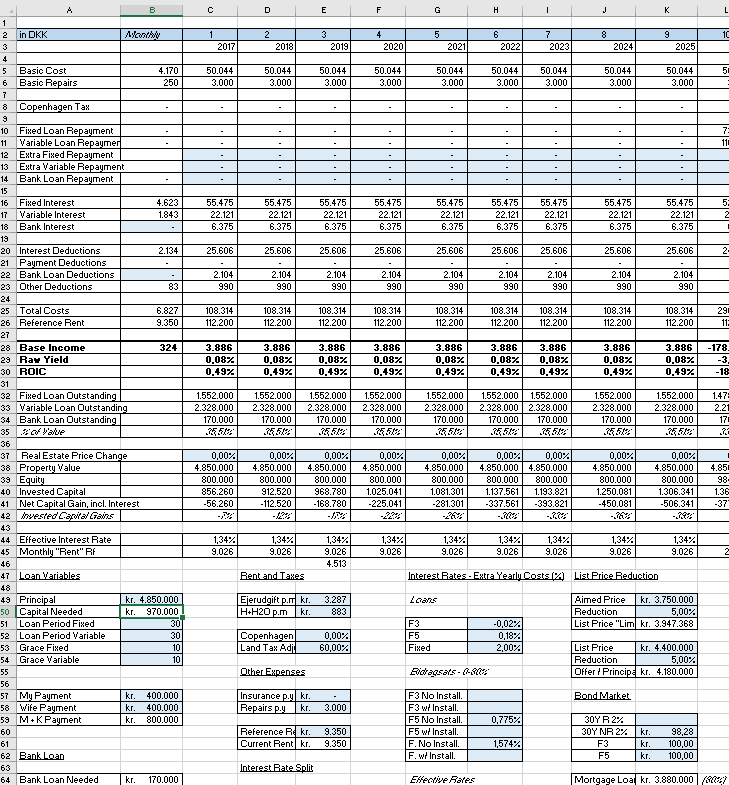
🧮 Constructing Your Cost Model
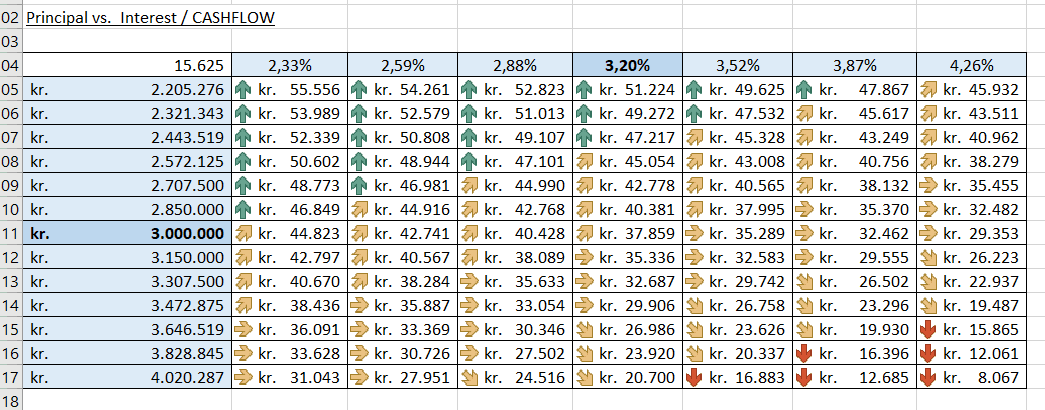
Before you start seriously shopping, build a financial model to understand your true monthly costs. Don't just focus on the purchase price — focus on monthly cashflow.
Your True Monthly Housing Cost Formula
Mortgage Payment (Realkredit 80%)X DKK
+
Bank Loan Payment (15%)Y DKK
+
EjerudgiftZ DKK
+
Utilities (Electricity + Internet)~700 DKK
Total Monthly Housing Cost= Total
Just PART of my whole cost model—every light blue field is editable
Sensitivity Table—how much would my cashflow per month be vs. renting
📊
💡 Don't Build This Manually
I have created an Excel template that calculates all of this automatically.
Set up alerts for your search criteria. Good apartments go fast.
💰 Part III — Bidding & Negotiation
You're ready to put in offers. You've done your homework. Now it's time to execute.
In this section, you'll learn what you need before you start bidding, and then how to negotiate to get the best price.
🏦 Step 1: Get a Bank Guarantee + Lawyer
Getting Your Bank Guarantee
Before you can make a binding offer, you need a bank guarantee. This is a document from your bank confirming they'll lend you money for the purchase.
Getting this requires a meeting with the bank. They'll review your finances, run credit checks, and ask about your plans. Plan for at least a week to get this sorted.
When meeting the bank, you should:
Explain your connection to Denmark — how long you've lived here, your job, your plans
Bring documentation — pay slips, SKAT reports, bank statements
Negotiate — interest rates on the bank loan, fees, access to no-repayment loans
Important: Meet with multiple banks. You'll get different offers, and you can play them against each other.
Hiring a Lawyer
In Denmark, buyers hire their own lawyer to handle the legal paperwork. The lawyer reviews all documents, ensures there are no legal issues, and handles the transfer of ownership.
Expect to pay around 10.000 DKK. Make sure you get a fixed price that covers everything — you don't want surprise fees.
🎯 My Personal Lawyer Recommendation
Poul Grotum — pg@vilsoe.dk or +45 3348 9070
Poul is the lawyer I hired the two times (2017 and 2025) when I bought a place. I can vouch that he's great— especially if you're a foreigner. Wholeheartedly recommended!
👀 Step 2: Finding & Visiting Apartments
Once you have your bank guarantee, you can start viewing apartments seriously.
What to look for when visiting:
Check windows — are they double-glazed? Any condensation?
Test water pressure
Look for signs of moisture or mold
Check the floor plan efficiency — how much is corridor?
Visit at different times of day for light and noise
Questions to ask the agent:
How long has it been on the market?
Why is the seller selling?
Are there any planned renovations or assessments?
What's the building's financial situation?
💰 Step 3: Making Bids — Negotiation 101
This is where you can save serious money. Danish real estate is negotiable — and most foreigners don't negotiate hard enough.
Information is Power
Before making an offer, gather as much information as possible:
Historical sales: What have similar apartments sold for?
Liggetid: How long has it been listed? Longer = more leverage
Seller motivation: Why are they selling? Are they in a hurry?
Building issues: Any upcoming renovations or assessments?
The Negotiation Strategy
Start with a low-ball offer — 8-12% below asking price. Don't be shy.
Justify your offer — Reference comparable sales, building issues, liggetid
Negotiate via email — Phone calls create pressure. Email gives you time to think.
Use "walk away" leverage — Make it clear you're looking at other options
Know when to stop — If you've gotten 5-7% off and it's a great place, take it
📧 Sample Negotiation Email
Subject: Offer for [Address]
Dear [Agent Name],
Thank you for showing us the apartment at [Address] on [Date]. We are interested in making an offer.
After reviewing comparable sales in the building and neighborhood, as well as the upcoming [mention any issues: high ejerudgift / planned renovation / time on market], we would like to offer 3,100,000 DKK.
We have a bank guarantee in place and our lawyer is ready to proceed. We can close within [timeframe, e.g., 4-6 weeks].
We are currently viewing other options, so we would appreciate a response by [date – give them 2-3 days].
Best regards,
[Your Name]
✅ Step 4: Once Your Bid is Accepted
Congratulations! Your offer was accepted. Here's what happens next:
Purchase Agreement (Købsaftale): Your lawyer reviews and you sign
Down Payment: Transfer to escrow (typically 5%)
Financing Approval: Bank formally approves and orders valuation
Title Transfer (Skøde): Lawyer handles legal ownership transfer
Closing Day: Get the keys, do final walk-through
Move In! Register your address with the municipality
Timeline: Typically 6-10 weeks from offer to keys.
🎉
You're Ready to Buy!
Buying an apartment is likely to be the biggest purchase of your life. For that, it helps to be as obsessed with the details as I was — the more you know about the laws, the financing options, the market and negotiating, the better deal you'll be able to get.
Want Even More Detailed Help?
I've created an exclusive video course called "Dream Home Denmark" with hours of detailed content, Excel models, and more.